Rebuilding Lower Manhattan
For 25 years, Mike Bloomberg’s leadership and vision have reshaped Lower Manhattan, including the World Trade Center.
Mike took the oath of office less than four months after the terrorist attacks of September 11, 2001, when the World Trade Center lay in ruins, Lower Manhattan remained in crisis, and the whole city was reeling. Many feared that businesses and families would flee and never return – and that the city would never recover.
Mike refused to allow 9/11 to become New York’s downfall. In his first year in office, he outlined a bold vision to transform Lower Manhattan from a 9-to-5 business district into a 24/7 residential neighborhood – and he began laying the foundation for New York City’s greatest comeback.
“The time has come to restore Lower Manhattan to its rightful place as a center of innovation and make it a ‘Downtown for the 21st Century.’”
– Mike Bloomberg in a speech to the Association for a Better New York in December 2002
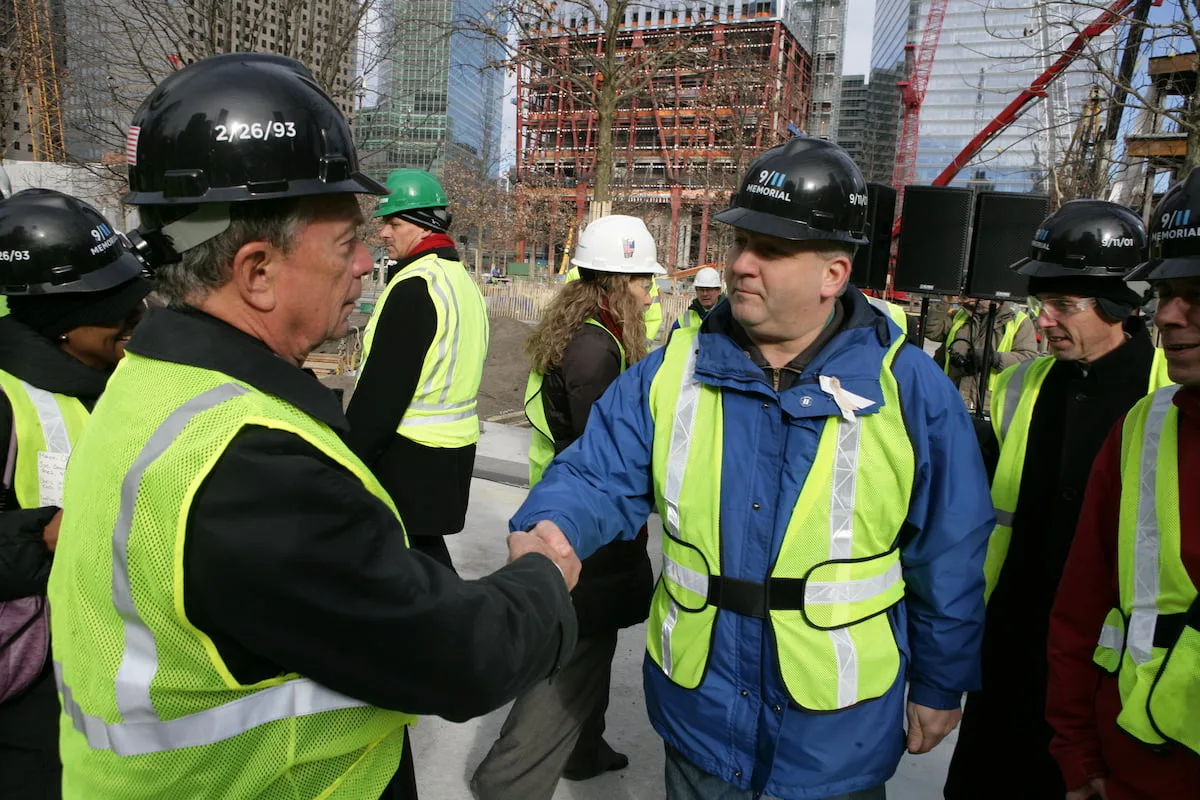
His vision for the post-9/11 rebuilding centered not on office towers, but people. His administration invested in new schools, parks, playgrounds, riverfront esplanades, picnic gardens, bicycle lanes, sports facilities, public art, and open spaces that reshaped Lower Manhattan into a family-friendly neighborhood. Mike also supported the creation and growth of arts and cultural organizations in Lower Manhattan, including the launch of the Tribeca Film Festival, which helped bring visitors back downtown. And he created small business incubator programs that welcomed hundreds of new startups downtown.
The rebuilding of the World Trade Center became one of the most complex projects in New York City history. The site was governed jointly by two states that had nine different governors over the 12 years following 9/11, with control and influence exerted by a number of public and private entities. After years of delays, costs to build the Memorial had ballooned to more than $1 billion, fundraising had stalled, and public confidence had waned. Fears rose that longstanding disputes over the site would never be resolved, and that the Memorial would never be built. In 2006, with design and construction still stalled, Mike stepped in and took over as chairman of the effort to build the 9/11 Memorial and Museum.
Mike set a clear public goal: open the Memorial by the 10th anniversary of the attacks. To do that, he brought parties together to resolve logjams, build consensus, bring down costs, and secure agreements that allowed construction to move forward. He worked closely with family members to help resolve longstanding concerns over the arrangement of victims’ names on the Memorial. He supported Memorial architect Michael Arad’s “meaningful adjacencies” concept, allowing names of people connected in life to remain together forever on the Memorial. And he galvanized donors, raising hundreds of millions of dollars.
On September 11, 2011, Mike opened the 9/11 Memorial, fulfilling his promise to the families and to New York City – on time and on budget.
“Overwhelmingly our decision to go back to lower Manhattan was Bloomberg’s reassurances that this would be a livable and safe place.”
– Marina Norville, American Express spokeswoman
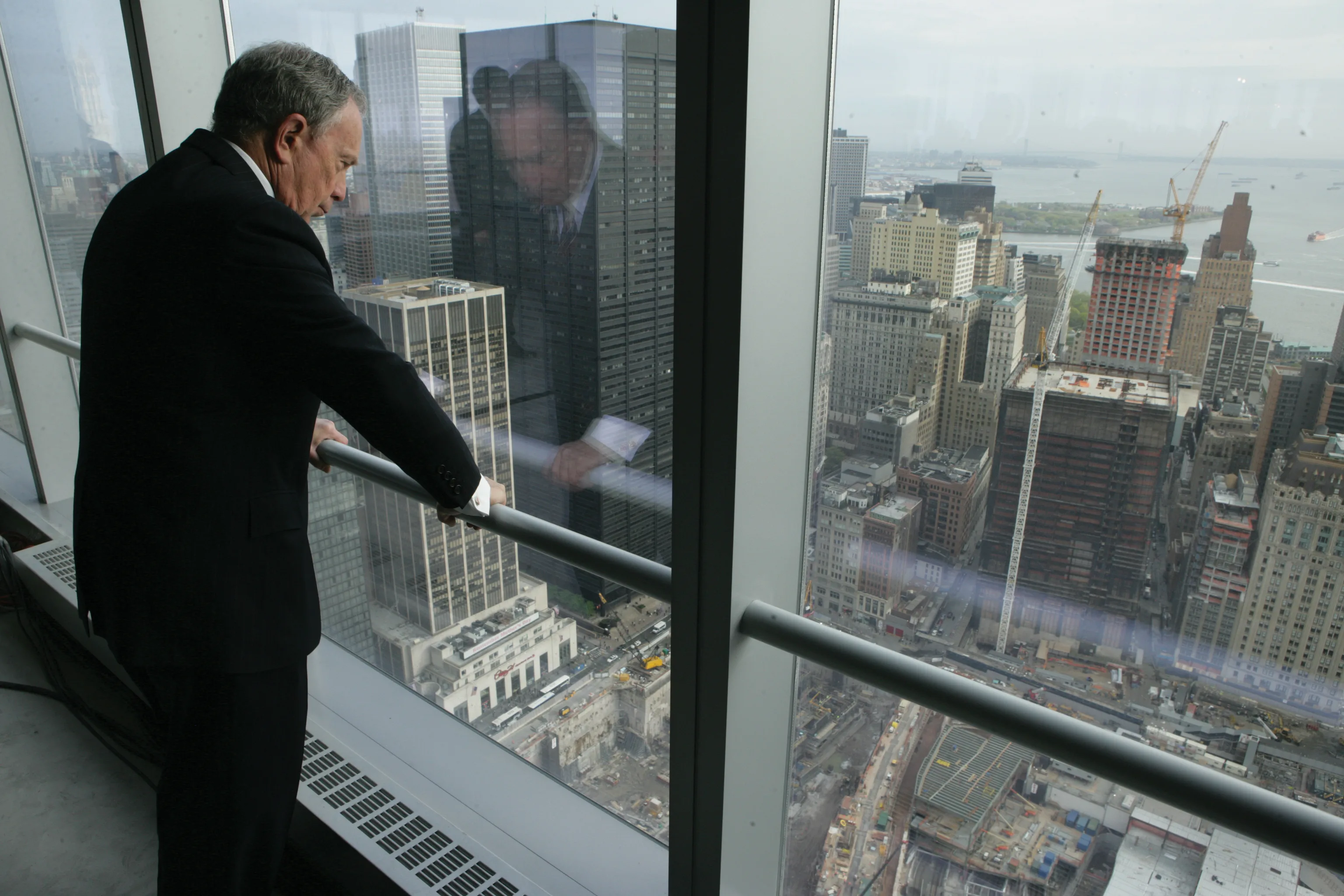
By the end of Mike’s mayoralty, there were more businesses and residents downtown than there had been before 9/11. A 9-to-5 business district once defined by office towers became a thriving, 24/7 neighborhood and an enduring symbol of New Yorkers’ resilience.
In 2014, Mike helped open the National September 11th Memorial & Museum, ensuring the stories and lessons of 9/11 will never be forgotten. Today, more than 100 million visitors have come to the Memorial and 26 million have visited the Museum, making it one of the world’s most visited historic sites. Mike has welcomed to the Memorial and Museum US presidents, heads of state, and a diverse array of religious leaders.
As mayor, Mike was deeply committed to building a cultural center at the World Trade Center site, even as others voiced skepticism, and he continued to champion the project after leaving office. In 2023, he helped open the Perelman Performing Arts Center (PAC NYC). Adjacent to the Memorial, the center is a distinctive marble cube featuring three theaters with flexible layouts that can accommodate multiple seating configurations for up to 1,200 people.
“The 9/11 Memorial, which opens today, is built as a place where we can touch the face of history – and the names of all those we lost. We also remember that out of a day of unspeakable horror, came an endless outpouring of human kindness that reaffirmed our connection to one another.”
– Mike Bloomberg at the opening of the Memorial
Today, Mike remains deeply committed to the mission he embarked on 25 years ago, through his work as chair of the National September 11 Memorial and Museum and of PAC NYC. Over the past 25 years, Mike’s fundraising for the three institutions has raised more than $900 million in donations, including more than $200 million from Mike himself.
Lower Manhattan’s vibrant street life, cultural revival, and ongoing economic growth – the final World Trade Center commercial tower broke ground in 2026 – reflects a vision Mike set in motion and continues to help fulfill.
Timeline Milestones
September 2001
It was primary day. Mike voted and was at campaign headquarters when he first got word. Three people from Bloomberg LP died in the attacks.
January 2002
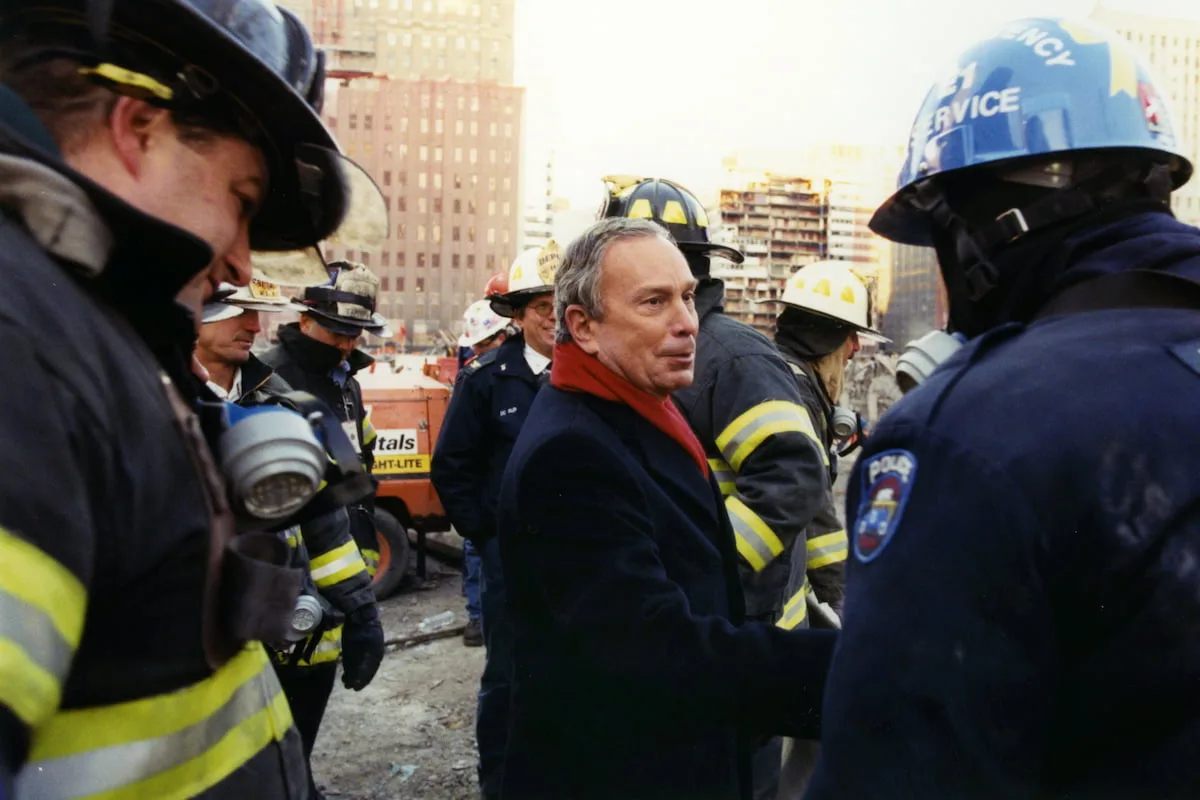
At Mike’s inauguration, smoke from the World Trade Center was still visible from the steps of City Hall. That afternoon, Mike visited recovery workers at the site.
May 2002
The official end of the recovery effort was marked by a ceremony and procession of the so-called “Last Column,” the last piece of the World Trade Center left standing. The 58-ton, 37-foot steel column returned to the site in August 2009 and today stands in the center of the Museum’s Foundation Hall.
August 2002
The New York Stock Exchange officially ended its headquarters expansion effort, begun four years prior and which would have cost the City $1 billion in subsidies. Mike had objected to the proposed project, citing its exorbitant cost to taxpayers.
November 2002
Construction began on 7 World Trade Center.
December 2002
Mike gave a speech at an Association for a Better New York (ABNY) breakfast at the Regent Wall Street, where he announced his vision to transform Lower Manhattan into a 24/7 residential neighborhood. His comprehensive plan included major investments in new parks and waterfront access, affordable housing, schools, and transportation.
April 2003
Mike and Governor Pataki announced the launch of what became the largest open design competition in history. A 13-member Memorial jury gathered feedback from family members and the public, together with the Lower Manhattan Development Corporation (LMDC). Jurors narrowed 5,201 submissions down to 8 finalists, which Mike and Governor Pataki reviewed.
January 2004
Jurors met to make a final decision. After 12 hours of voting, they selected Michael Arad’s “Reflecting Absence.” Arad’s proposal included landscape architecture by Peter Walker. At the time, Arad was a City employee. He worked as an architect at the New York City Housing Authority.
December 2004
Mike and Governor Pataki announced the launch of a private foundation to assume responsibilities from the LMDC for a memorial. This organization would become the National September 11 Memorial & Museum.
January 2006
Mike stepped in and assumed leadership of the Memorial. He became chair of the Memorial foundation board and took on responsibility for fundraising.
April 2006
Construction began on the “Freedom Tower,” One World Trade Center.
May 2006
7 World Trade Center opened.
January 2008
Construction began on 4 World Trade Center.
April 2008
Eighteen months after Mike became chair, the Memorial foundation reached its $350 million goal for its capital campaign. Overall, the Memorial & Museum has raised nearly $760 million in private donations.
April 2008
Mike welcomed Pope Benedict to the World Trade Center site.
May 2009
Construction was again at a stalemate. As talks between the Port Authority and Silverstein Properties faltered, Mike convened a summit at Gracie Mansion. Out of that meeting came the framework for a compromise deal that Mike helped seal the next year.
June 2009
The placement of the names on the Memorial was controversial. Mike took a hands-on role working with Michael Arad and advised him to use the “meaningful adjacencies`` concept, with names placed near those with whom a person shared a personal or professional bond.
December 2009
With financial support from the City, the Downtown Alliance’s tech and media incubator The Hive opened at 55 Broad Street.
December 2010
The “Survivor Tree” was planted at the 9/11 Memorial area of the World Trade Center.
May 2011
The National September 11 Memorial & Museum released the final arrangement of the victims’ names to the family members.
September 2011
Meeting Mike’s stated goal, the Memorial opened to family members on the 10th anniversary of the attacks. It opened to the public the following day.
September 2013
Mike gave a speech at 7 World Trade Center recapping the city’s successful efforts to rebuild Lower Manhattan. Mike detailed the neighborhood’s population growth, job growth and economic recovery, the rise of the downtown tech industry, investments in new schools, parks, and waterfront access, and more.
November 2013
Mike helped cut the ribbon at 4 World Trade Center.
May 2014
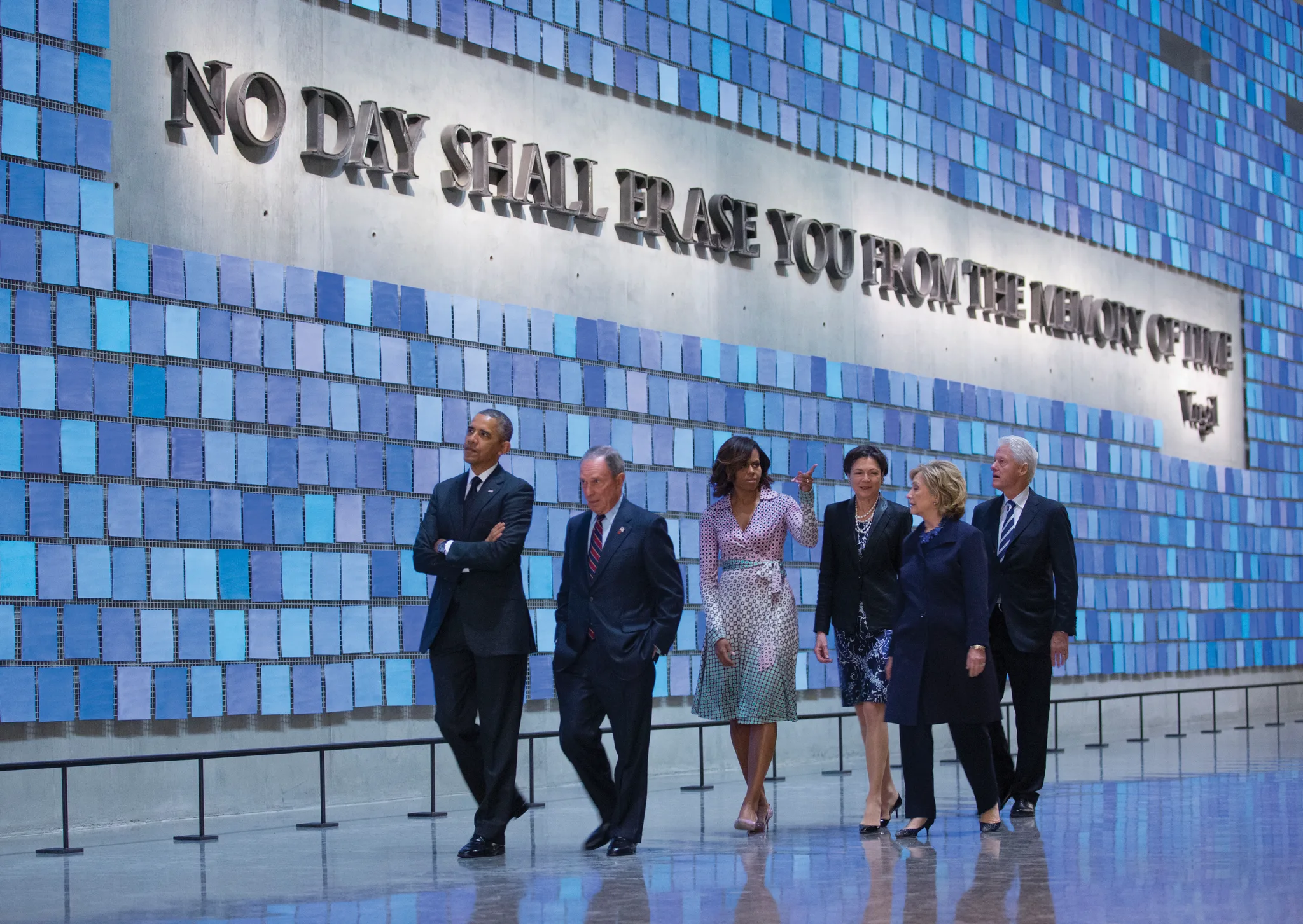
The Museum first opened to family members and 9/11 stakeholders. At the opening cermony, Mike spoke alongside U.S. President Barack Obama. He then gave a tour to President Obama, U.S. First Lady Michelle Obama, U.S. President Bill Clinton, and Secretary of State Hillary Clinton. The Museum opened to the public on May 21st.
June 2014
After beginning in 2010, construction resumed at 3 World Trade Center.
November 2014
One World Trade Center officially opened.
September 2015
Mike welcomed Pope Francis to the Memorial & Museum.
June 2018
3 World Trade Center officially opened.
May 2019
Joined by Jon Stewart, Mike spoke at the opening of the 9/11 Memorial Glade, which honors the thousands who participated in the rescue and recovery effort.
September 2019
With structural steel work below grade complete, the first cranes rose at the site of the Performing Arts Center.
July 2020
Mike became chair of the Performing Arts Center.
June 2021
Mike commemorated the completion of major construction at the Performing Arts Center. He was joined on the roof by Ronald Perelman, board members, donors, and the design and construction team.
September 2023
Mike spoke at the opening night celebration of the Perelman Performing Arts Center. The New York Times called PAC NYC “the most glamorous civic building to land in New York in years.”
March 2026
Vertical construction began on 2 World Trade Center, future global headquarters of American Express and the site’s final commercial tower.