
Bloomberg Philanthropies has a special relationship with Governors Island, and in the wake of Mayor Eric Adams’s announcement about its future, I wanted to take a moment to share more about our commitment to it.
When the Mayor’s Office approached us about supporting their initiative to develop a first-of-its-kind Climate Exchange on the island, in collaboration with Stony Brook University and others, we were thrilled. It would be hard to imagine a climate project that better aligns with our approach (it involves city leadership, education, innovation, and public-private partnerships) and with Mike’s vision for the island, which goes all the way back to his first run for mayor.
Back in 2001, a month after the devastating 9/11 attacks, Mike gave a campaign speech promising to reimagine Governors Island as a place for students and entrepreneurs, with a university campus and a public school. It might sound obvious now, but back then, it wasn’t. His opponent said he was “displaying the naivete of a novice.” It was easy to be skeptical – after all, the island had been stuck in a political stalemate for almost a decade.
A quick refresher on the island’s recent history: In the mid-1990s, shortly after the federal government announced that it would close the Coast Guard base that had been on the island since the 1960s, Senator Daniel Patrick Moynihan and then-President Bill Clinton took a helicopter flight over the harbor and agreed to transfer ownership of Governors Island from the federal government to New York City for one dollar. Moynihan saw the transfer as a way to preserve the island’s historic buildings and create a public park that would be accessible to all New Yorkers – opening the island to the public for the first time. Sadly, the proposal became entangled in negotiations over how the island would be used, and Congress required the land to be sold for its market value, assessed at $500 million. In the years that followed, nothing happened.
As he campaigned for mayor, Mike understood the need to break the impasse. And when skeptics criticized his vision for the island, he replied: “If somebody’s got a better idea, I would be happy to hear it, but it is time to do something. Let us have this piece of property and let us develop it for something that is good for this city and good for this country.”
His timing was perfect. In the aftermath of 9/11, the entire country came to New York’s aid, and the Bush administration sought to be helpful. After Mike was elected, it was Laura Bush, a former teacher, who heard about his proposal for Governors Island and asked the White House to look for a way to give the island to the city so that it might be used for education. With the city facing a historic budget deficit, there was no way our administration could afford $500 million – or anything close to it. But the White House determined that because major commercial development of the island would be blocked, the land – technically speaking – had virtually no market value. That allowed the Bush administration to transfer the land jointly to the city and state for a nominal amount and without congressional action.
There was an enormous amount of work to do. Many of the island’s historic buildings were in disrepair, and it lacked the kind of modern infrastructure necessary for public use. But Mike saw the potential for the island to become a “Central Park in the Harbor,” and we began the work of transforming it into a destination for arts, culture, and recreation – and education.
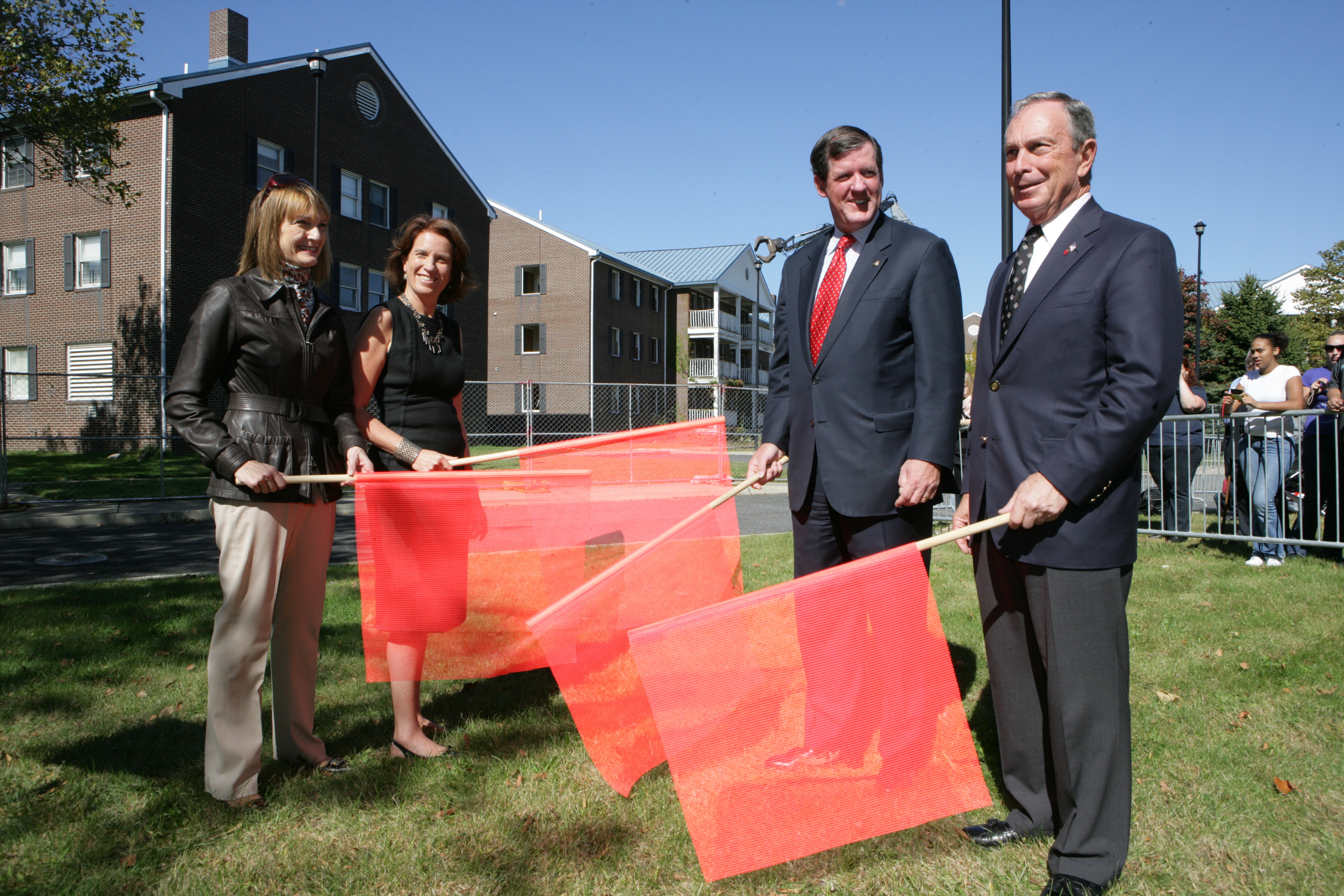
Patti Harris, Governors Island Preservation and Education Corporation President Leslie Koch, Deputy Mayor Robert Lieber, and Mike Bloomberg initiated the demolition of 10 buildings not built to City building code standards, October 2008. Photo Credit: Courtesy of the City of New York
Under Mike’s leadership, and with an awful lot of hard work from a team led by the amazing Ronay Menschel and Leslie Koch, the island’s historic buildings were renovated and repurposed, and new public spaces were created. The Harbor School, a public high school that focuses on marine science and technology, opened in 2010, with about 500 students. And we worked with art and cultural partners to bring a broad array of events, exhibits, and festivals to the island. We strongly believed that the more New Yorkers experienced the island, the more they would support efforts to invest in it. But we also encountered an unexpected challenge.
The 2008 financial crisis and the Great Recession created a budget crisis in Albany that threatened to slow progress on the island. Rather than lobby for more money, Mike decided to make a bolder push: to ask Albany to grant the city full control of the island, which would allow us to develop and implement a five-year capital plan without having to depend on Albany for support. It worked: The state ceded control, we came up with the capital dollars, and we moved full steam ahead.
In the years that followed, we began building the Play Lawns, 10 acres of open fields, hammocks, and public art installations. The lawns are a popular spot for picnics, frisbee games, and other outdoor activities. We designed the island to sustain flooding that might arise from climate change, and we also broke ground on what has proved to be one of the island’s most popular public attractions, The Hills, which reach 70 feet high and are made of recycled construction materials. They offer stunning views of the harbor, the Manhattan skyline, and the Statue of Liberty. Last year, more than 1 million visitors came to the island.

Mike Bloomberg and Patti Harris participate in ribbon cutting ceremony for the opening of The Hills on Governors Island, July 2019
The creation of The Hills and Play Lawns has helped turn Governors Island into just what Mike imagined – a Central Park in the harbor, accessible to all New Yorkers and visitors. Earlier this year, Mayor Adams announced that the Harbor School will expand, doubling the number of students it serves. And his recent announcement of the creation of the NY Climate Exchange – in partnership with SUNY Stony Brook and with support from Jim Simons, Bloomberg Philanthropies, and others – will bring more students, researchers, faculty, and entrepreneurs together to tackle a challenge that Bloomberg Philanthropies is deeply devoted to addressing.
Reimagining Governors Island wasn’t the first “naive” idea Mike had. He heard plenty of naysayers when he decided to start a company and run for mayor, too. But it shows how his belief in big and bold ideas – which is embedded in the culture of both the company and Bloomberg Philanthropies – makes anything possible.
Patricia E. Harris is the CEO of Bloomberg Philanthropies and served as first deputy mayor of New York City during the Bloomberg administration.