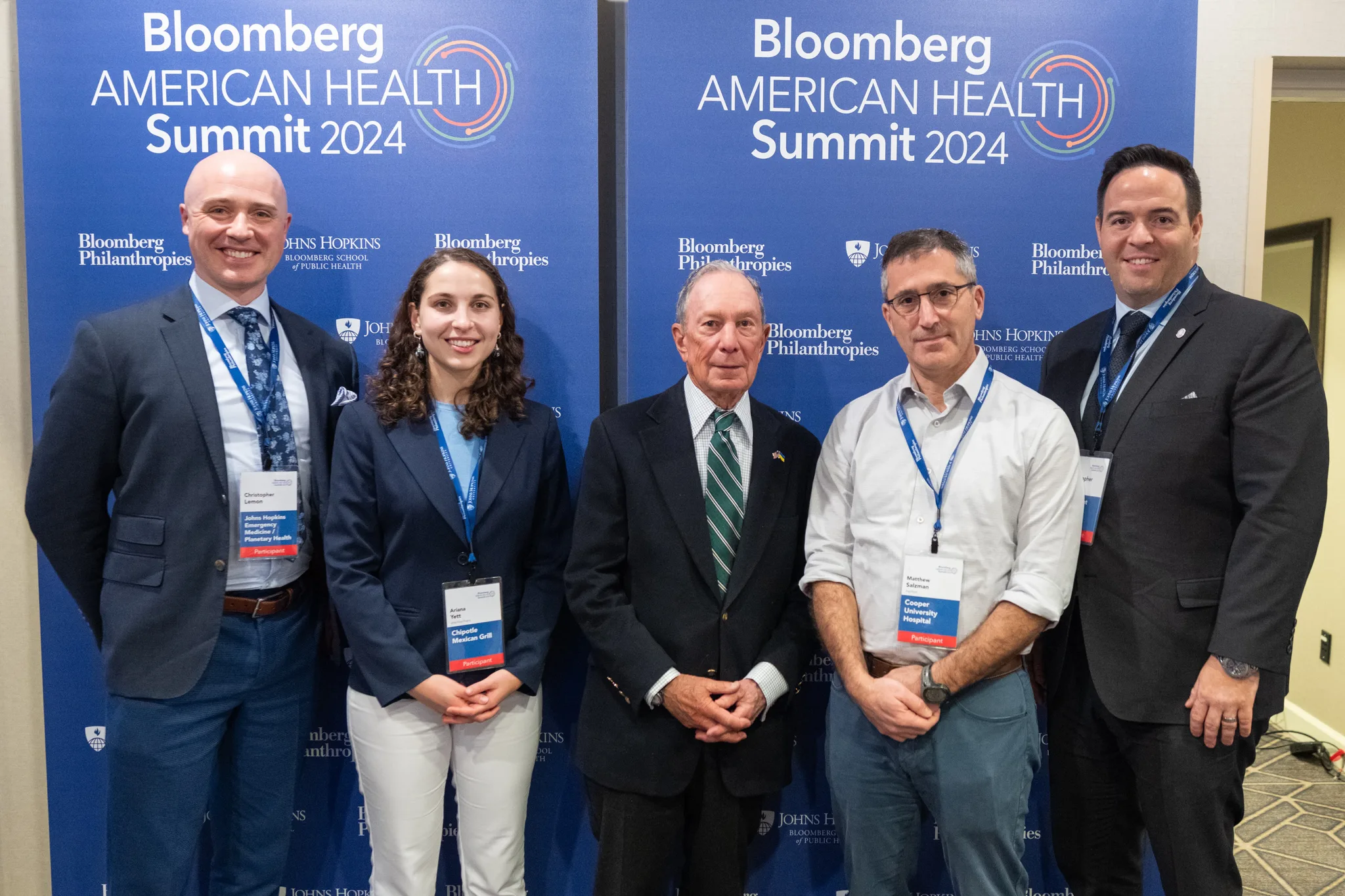
Photo: Mike Bloomberg with Bloomberg American Health Fellows from the Johns Hopkins Bloomberg School of Public Health
Remarks as Delivered in Washington, D.C.
Good morning, everyone and welcome to the Washington, D.C. seventh annual Bloomberg American Health Summit.
Let me say thank you to Ron Daniels, as well as the leadership at the Johns Hopkins Bloomberg School of Public Health: Josh Sharfstein and Michelle Spencer.
And a special thanks to Dean Emeritus Al Sommer, and current Dean Ellen MacKenzie. You should know that Ellen’s time as dean is winding down, and for all the incredible work she’s done, let’s give her a big round of applause.
Now, I graduated from Johns Hopkins University 60 years ago. That’s the class of ’64, for anyone trying to do the math.
It’s fair to say I spent as much time organizing fraternity dances as I did at the library – and if I had told my professors that one day the public health school would bear my name, they would’ve laughed me out of class.
Of course, back then, if I had also said that one day someone who opposes vaccines for deadly diseases would be nominated to run the Department of Health and Human Services, they would have laughed even harder. But sadly, and shockingly, it’s no laughing matter.
When I was growing up, one of the biggest fears parents had was that their children might contract polio. I remember the cover of Life magazine showing a gymnasium full of iron lungs with people having their heads sticking out, looking helplessly at the camera.
The disease paralyzed and killed thousands of people before the vaccine was introduced in 1955. Thanks to that vaccine and others, polio, and other diseases – like measles and mumps – are now exceptionally rare.
Before vaccines, a half million people contracted measles every year – and 10 percent were hospitalized. 200,000 got diphtheria every year – and some 15,000 of them died. In fact, over the past half-century, vaccines have saved the lives of millions of Americans – especially children.
Making it harder to get vaccines would be one of the most catastrophic mistakes in American history – a travesty beyond measure.
I’m hopeful that Senate Republicans will convince President-elect Trump to re-think the nomination of Robert Kennedy, Jr. And the President has good reason to re-think it.
In fact, Kennedy has attacked what may be President Trump’s biggest first-term accomplishment: Operation Warp Speed, the federal effort to fast-track development of a vaccine for Covid-19. It saved millions of lives, allowed the economy to re-open, and helped Americans get back to their normal routines – and it continues to do that.
President Trump does deserve real credit for Operation Warp Speed – yet Kennedy has made the outrageously false claim that it was, quote: “the deadliest vaccine ever made.” And that it – quote – “may have caused more harm than good.”
In reality, studies show the vaccine saved some 20 million lives.
Now, just imagine if RFK Jr. had been in office during Trump’s first term. Would Operation Warp Speed have even happened? And if it did, how long would the vaccines have been delayed? How many fewer people would’ve gotten the shot? How many more people would have died? How much more damage would that have done to our economy?
All we can say for sure is this: It would have made Covid even more deadly, and even more economically painful.
And so, the question now is: How much worse might the next pandemic be under a Secretary Kennedy? Sadly, the reality is: The next one may already be on our doorstep.
Thankfully, the H5N1 bird flu and Mpox viruses – which are deadly – remain fairly isolated – for now. But whether it’s those viruses – or a different virus that emerges – the next pandemic isn’t a question of “if.” It’s a question of when.
We need government leaders who are capable of preparing and responding effectively – including by supporting the development of new vaccines. Putting RFK Jr. in charge of that work would be beyond dangerous. It would be medical malpractice on a mass scale.
Now, I understand the frustration that parents felt around school closures – and I shared it. Thanks to the outrageous opposition of the teacher’s unions to re-opening schools, too many schools stayed closed for far too long – and children paid a terrible price.
But as bad as that was, the price children would pay if resistance to vaccines – or inability to access them – becomes commonplace that would be far, far worse.
Parents who have been swayed by vaccine skepticism love their children and want to protect them. We need leaders who will help them do that – not conspiracy theorists who will scare them into decisions that will put their children at risk of disease and even death.
Kennedy has said that when he’s hiking and passes people on the trail with kids, he tells them, quote: “Better not get them vaccinated.” Well, if parents listen to him, their children are more likely to become severely sick – and even die.
I remember in 2019, when an incorrectly prepared vaccine for measles led to the death of two children in Samoa, Kennedy traveled there – and he and his organization fanned the flames of fear and misinformation. As a result, vaccination rates dropped, and more than 5,700 people contracted measles. Tragically, 87 people – most of them children – died.
Just think of the parents of those children – and the suffering they are still feeling, and now think of what a similar situation would look like in the United States.
In Samoa, vaccine hesitancy killed 87 people out of a population of 200,000. If we apply that percentage to the US, the death toll would have been about 150,000 people – most of them young children.
It’s beyond comprehension that we could inflict this kind of damage on our own nation, our own communities, our own families. And already, we are seeing glimpses of the dangers in places like Michigan, where surges in whooping cough cases are the result of declining vaccination rates.
Kennedy’s attacks on vaccines are part of a worldview that sees conspiracies everywhere and can’t be bothered with facts. He still claims that vaccines cause autism – even though an abundance of data makes clear that they don’t. He’s also said that anti-depressants cause mass shootings, and exposure to Wi-Fi damages the brain, and that the water vapor airplanes leave in their wake is actually a top-secret chemical spray used for nefarious purposes.
It’s all nonsense with no evidence whatsoever. But he doesn’t care about evidence – and that’s the real danger.
Because it’s one thing to joke about the way some people call lies “alternative facts” and actual facts “fake news.” But when reality is reversed on vaccines and medicine – when people are led to believe that what is up is down, what is dangerous is safe, and what is safe is dangerous – many, many people will die.
As bad as that scenario is, it gets worse. As Secretary, Kennedy could slow or stop approvals of new treatments and vaccines – and even try to revoke approvals already granted. He could encourage litigation against vaccine manufacturers and, by doing so, discourage investment in new cures. And he could allocate research dollars away from life-saving work and toward junk science.
As this group knows: Project 2025 calls for research funding to be distributed through block grants to states, rather than going to universities and research institutions that are leading the most promising work.
If we allow research money to be doled out like political pork, and for pseudo-scientific theories, then America will forfeit its place as the best country in the world for medical research, and millions will die early – and we cannot afford to let that happen.
The COVID vaccine that Trump championed is a case in point: The successful use of MRNA has opened up immense promise in the fight against other diseases, work now going on by medical researchers applying science to improve and save lives – the work that this group helps make possible.
Now, I’ve heard a few Democrats express some sympathy for Kennedy, because he has been critical of the junk food and processed food industries. But we don’t need to choose between someone who is pro-healthy food and pro-vaccine. Americans deserve both.
And let me tell you: You’re not going to find anyone who has more scars from battling the junk food and processed food industries than I do. Just try to tell them they can’t drink. In City Hall, we banned trans fats – over industry opposition. We pushed the industry to reduce salt in foods – and we won. We fought the fast-food chains to put calorie counts on menus – and we won. And we took on the soda industry with a plan to reduce consumption of sugary drinks.
Those battles – and others we fought – are reasons why the average life expectancy of New Yorkers increased by three years during our time in office.
They were lonely battles – but we fought them to save and improve lives, and we are still fighting them – through the work of Bloomberg Philanthropies, and through my role as the World Health Organization’s Global Ambassador for Noncommunicable Diseases
Over the years, Bloomberg Philanthropies has invested a great deal of money to prevent noncommunicable diseases, like diabetes and heart disease. But if the federal government steps back from vaccines, all of that progress will vanish.
How many Americans will needlessly and tragically die from infectious diseases is anyone’s guess. 100,000? A million? Two million?
And if the federal government starts re-allocating science funding to nutty conspiracy theories, how many years will that set back a cure for cancer? And Leukemia? And ALS? And Alzheimer’s? And Parkinson’s? And every other disease that needs more funding.
It boggles the mind that the Senate would even consider giving Kennedy any power whatsoever over American health policy. Whatever one may think of his positions on food policy, it’s nowhere near enough to overcome his opposition to vaccines.
A Secretary Kennedy would set back the goal at the heart of our work together: helping Americans live longer, healthier, lives.
We started the Bloomberg American Health Initiative in 2016 to combat the decline in life expectancy our country was experiencing. We set out to focus on the most pressing threats to American health: addiction and drug overdoses, adolescent health, environmental challenges, obesity, and gun violence.
We’ve made some important progress in each of those area – thanks in no small part to everyone here today, including our Bloomberg American Health Fellows, as they work toward their master’s or doctorate degrees.
For example, our Fellows have conducted research that has helped pass gun safety measures in 21 states – including red and purple states – which is keeping guns out of the hands of potentially violent people.
For example: In Minnesota, our fellows are tackling domestic violence against Black women and girls – who make up just 7 percent of the state population, but sadly, 40 percent of domestic violence victims. In coordination with state legislators and activists, they helped create the nation’s first ever office dedicated to tackling this crisis.
I’d like to ask all the Fellows in this room who are working hard to make a difference across America to please stand, and let’s give them a big round of applause.
To help put the state of American health in context, the Bloomberg American Health Initiative is releasing a study today that compares life expectancy in the U.S. to the U.K.
In the UK, people live about 2.7 years longer, and men live 3.5 years longer, than they do in the U.S.
Researchers found that these gaps can be explained by four preventable causes – cardiovascular disease, drug overdoses, motor vehicle crashes, and guns – the very issues our work focuses on, and we know we have a long way to go.
Despite having the world’s largest economy and most advanced healthcare facilities, America still ranks 40th in the world in life expectancy. Think about that: 40th!
Can anyone imagine the national uproar that would have occurred if America had finished in 40th place in the Olympic medal count? People would have been up in arms, seriously! And every elected official would have been calling for heads to roll and policies to change! But when we finish 40th in life expectancy, they hardly utter a peep about most of the main causes.
It’s hard to say which is more disgraceful: finishing 40th or having leaders shrug their shoulders about it. And just imagine how much farther we will fall if Kennedy is confirmed.
We can’t allow Kennedy or Trump – or anyone else – to bring unimaginable suffering to the American people.
So, if the president-elect doesn’t reconsider the nomination, the Senate has a duty – to our whole country, but especially to our children – to vote “no.”
Those senators considering a “yes” vote should ask themselves:
With the nation facing a possible bird flu outbreak, are they really prepared to roll the dice on the lives of their constituents, by placing someone in charge of public health who has made it clear that he or she will prevent the approval of life saving vaccines?
And they should remember: In November, Americans voted for change, but they did not vote to bring back polio and measles and other deadly diseases.
Throughout my career – in building a company, in running New York City, in pursuing our philanthropic work – I have always led with a commitment to data and facts. I guess it’s the Hopkins trained engineer in me.
I believe in science. And for generations, Americans did, too – which produced innovations and breakthroughs that changed the world, time and again.
But now, too many Americas reject facts and seek their own.
The burden is on us to unite our nation behind an optimistic belief in the science of vaccines and future cures that will save countless lives. Ours is a mission of public health. It is noble. It is needed. And it is our job to bring everyone along.
Of course, it’s not going to be easy – and there may be setbacks. But this group is critical to making progress on public health in U.S., and our team at Bloomberg will be here to support you – not only in the lab, but also in the halls of power.
Let me close with one final thought: If ever there were an issue that both parties should strongly support, it’s vaccines. After all: We might not even be a country were it not for vaccines.
You’ll love this story, back in 1777 – before I was even born – after the Continental Army had suffered a series of defeats, General George Washington feared that the war could be lost to smallpox, which was killing soldiers and harming recruitment. Incredibly, around 90 percent of the army’s casualties were due to infectious diseases – most of them from smallpox. British soldiers had been exposed to the disease in Europe, which gave them some immunity – and a military advantage.
So, Washington took a bold and controversial step: He mandated that all soldiers be inoculated.
And despite public fear and distrust of inoculation, the soldiers complied.
Over the coming months, a mass inoculation effort took place across the army. As a result, rates of infection fell, along with the threat of outbreaks, which saved lives, and also led to a surge in new recruitment.
Without that move, the war may well have been lost – and the greatest nation on earth would have, like so many children who lived before the age of vaccines, died in the cradle.
So: As we gather in this city named for Washington, on the road that connects the White House and Congress, we want both ends of Pennsylvania Avenue – and both parties – to hear us when we say: It is a patriotic duty to leave politics out of vaccines, out of medicine, and out of scientific research.
Thank you all for your leadership – and for coming together today to find new ways to expand and accelerate your work.
We have a great agenda ahead, and I’d like to turn the floor over to Josh Sharfstein and Michelle Spencer. Both Josh and Michelle have been great partners to our public health team at Bloomberg Philanthropies, led by Dr. Kelly Henning, who we are very fortunate to have.
We’re grateful for all the work they’ve been doing, and I know the Bloomberg American Health Initiative is in good hands with their leadership.