Delivered at the National Medical Association 2024 Annual Convention and Scientific Assembly in New York City
Hello, everyone. Thank you, Dr. Frederick, for the nice introduction – and for all your leadership and partnership. Let me thank Dr. Lawson and the National Medical Association for inviting me to be part of this convention – and everyone here for the work that you do every day to save and improve lives.
It’s also my pleasure to welcome the out-of-towners to the place we New Yorkers humbly call the greatest city in the world.
When people ask me what I’m most proud of from our administration’s 12 years in office, seriously my answer comes down to a single number, and that number is the number three.
That’s how many years that life expectancy increased for New Yorkers during our administration, thanks to our focus on public health.
By the time we left office, New Yorkers were living more than two years longer than the average American. I used to tell people: If you want to live longer, move to New York!
One major reason we were able to make those strides is the work we did to reduce tobacco use. The National Medical Association has been a critical leader on that issue for many years, and we owe you a big thanks, because it really has helped save an awful lot of lives. But we still have a long and an awfully long way to go – and not just on tobacco use.
The fact of the matter is: American health is in a state of crisis, and so we need your leadership and your advocacy more than ever. Life expectancy in the U.S. has begun to rise again after the worst decline since the 1920s, but it still hasn’t rebounded to where it was before the pandemic, and we continue to lag far behind other countries.
And while life expectancy is just one measure, it’s a good way to see how effectively we’re countering the biggest threats to public health. It also shines a bright light on the racial inequalities that persist, because – as the members of this group know very well – life expectancy for Black Americans is about five years less than it is for white Americans.
Think about that. Sixty years after the Civil Rights Act, a person’s race and family income still affect how long they are likely to live. And sadly, race and income still affect people’s ability to get a great education and pursue their dreams.
That’s unacceptable, and I believe every sector of society – public, private, and nonprofit – has an obligation to confront it.
Breaking down barriers to opportunity was at the heart of our work here in New York City and we saw that progress really was possible. For instance: On education, our administration began closing the difference in graduation rates between Black and white students.
And our commitment to break down barriers has continued to grow through our foundation, Bloomberg Philanthropies. And one way we do that is by working to increase diversity on college campuses. We formed a national coalition of colleges whose presidents are committed to that goal – the coalition is called the American Talent Initiative – and we are holding colleges accountable for progress. We’ve also created a program called College Point, the other side of the equation. That works with talented high school students from lower income backgrounds to ensure that more of them apply to selective schools – and get the financial aid they need to attend and graduate.
Another way we are working to end disparities is by focusing on the racial wealth gap, an effort we launched in 2020. We call it the Greenwood Initiative, after the thriving Black community in Tulsa, Oklahoma that was destroyed many years ago by racial violence, because the legacy of racial discrimination in America continues to be seen in family bank accounts.
We’ve also taken direct aim at a barrier that members of this organization are all too familiar with, one that threatens our ability to tackle the big problems plaguing American health. That barrier is: the soaring cost of medical school. The prospect of taking on crushing debt can deter many talented students from pursuing careers in medicine, particularly students from low-income backgrounds.
That has major consequences for Black health because – as the data shows, and as this group knows from experience – when Black patients are treated by Black doctors, in many cases they get more frequent care, more preventative care, and have better health outcomes.
So, by increasing the number of Black doctors, we can help to save more Black lives and reduce inequality in American health. That will also help to address racial wealth inequities – because debilitating health problems take an enormous economic toll on families and communities. Reducing the financial burden of medical school is one important part of the equation.
In 2020, during the heart of the pandemic – at a time when Black Americans were being killed by COVID at a rate nearly four times that of white Americans – Bloomberg Philanthropies made a gift of $100 million split between the four historically Black medical schools.
Those four schools alone graduate around half of all Black doctors in the United States, which really is an astounding stat. So there is no way to overstate how important they are to equality in medicine.
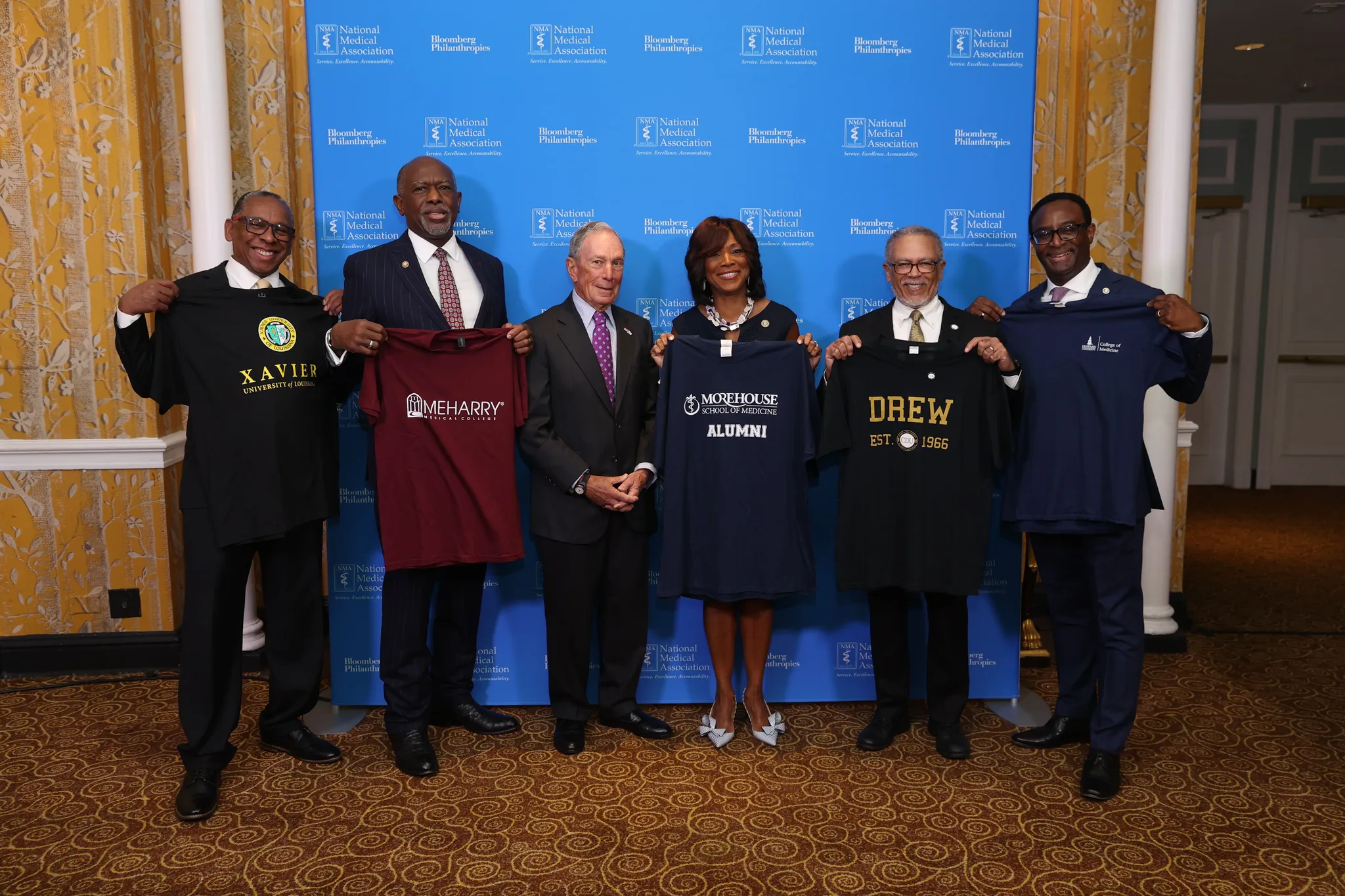
Their presidents are with us today – and I want to thank all of them for their leadership: Dr. David Carlyle, of Charles Drew University of Medicine and Science; Dr. Ben Vinson, of Howard University; Dr. James Hildreth, of Meharry Medical College; and Dr. Valerie Montgomery Rice, of Morehouse School of Medicine.
I’ve had the chance to talk to and learn from some of the students at each of those schools, who have now gone on to become doctors. And since we have some of their students and graduates here with us today, I’d like to ask anyone who ever graduated from or attended one of those four medical schools to stand up. Let’s give them a big round of applause!
We can see the results of our 2020 investment in the success of individual students and graduates – and in the overall data. I’m glad to say that because the burden of debt has been reduced, more students are making it to graduation. Less debt is also giving graduates more freedom to practice where need is greatest, rather than where compensation is highest. More graduates are working in primary care and emergency care than even before, certainly than before our investment. And more are choosing to work in underserved communities, in public hospitals, and in cities. I’m also glad to say that the schools have been able to leverage our support to attract more funding from other donors.
I mention those facts because we have a saying at our foundation: In God we trust, everyone else bring data. Data points us to problems and potential solutions that are getting overlooked – like the connection between Black doctors and Black health. By many important measures, the data shows that our investment in historically Black medical schools has been a success, and that’s thanks in large part to strong leadership at each of those schools.
But we have much more to do to build a community, a country where every person, regardless of race, has equal access to quality care, and where students of all backgrounds have the chance to enter medicine.
At Bloomberg Philanthropies, we want to do our part. And so today, I’m glad to announce a new gift to America’s historically Black medical schools from Bloomberg Philanthropies – $600 million.
Thank you.
The new funding will bolster the endowments of these four medical schools. We will also be making a gift to help establish a new medical school at Xavier University of Louisiana, an HBCU with a strong track record of sending graduates into medicine. We’re glad to have the President of Xavier, Dr. Reynold Verret, here with us. A nice round of applause for him.
The funding will help ensure long-term financial stability for each of these vital institutions, which really is so important. To put it in perspective: This gift will more than double the total endowments of three of those four medical schools.
You know, when I was told that it’s the largest gift ever given to HBCUs, I thought of the two people who would’ve been most proud of it: My mother and father.
I’ve told this story before, but one of my earliest memories of childhood is sitting at the kitchen table and watching my father write a check for $50 to the NAACP. We didn’t have much money – and we weren’t Black – so I asked my father why he was making the gift. And he said something that stayed with me the rest of my life – well, all my life so far: Because discrimination against anyone is a threat to us all.
I’ve carried that lesson with me throughout my life, and this is one more way that I’m trying to honor what my parents taught to me – and to pass that lesson on to my grandchildren.
When the National Medical Association was founded in 1895, there were 14 Black medical schools, compared to only four today. Lack of funding and support, driven in no small part by prejudice and racism, forced many to close their doors. We can’t allow that to happen again – and this gift will help ensure it doesn’t.
Diversifying the medical field is a society-wide challenge. Philanthropy can’t do it alone – but we hope this commitment will help to attract more support. Your leadership and advocacy are critical, too – so let me again thank everyone here, for everything you do, to build a brighter future for the patients you serve, and the country we share.
And thanks again for having me. All the best.
Learn more about Bloomberg Philanthropies’ investments in Historically Black Medical Schools